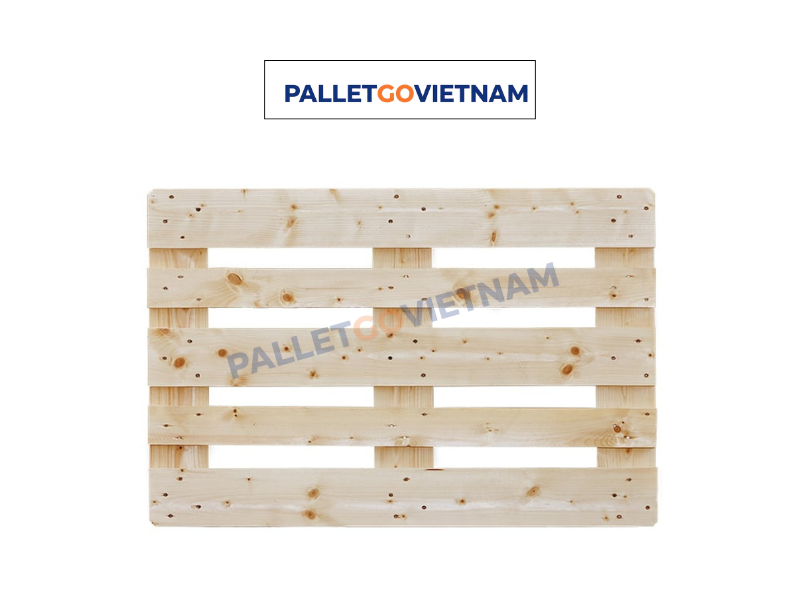
- ISPM-15 compliant - every pallet heat treated at 56°C core for 30 minutes, IPPC/HT stamped on two opposite sides
- IPPC-registered facility in Vietnam - producer code issued by the Vietnamese Plant Protection Department, country code VN
- HT treatment only - no methyl bromide (MB), accepted in the EU, USA, Japan, Korea, Australia and 180+ countries
- Full export documentation - heat treatment certificate, phytosanitary certificate, commercial invoice with HS code on request
ISPM-15 Heat Treated Wooden Pallets from Vietnam - IPPC Registered, HT Stamped
ICD Vietnam manufactures ISPM-15 compliant heat treated wooden pallets at our IPPC-registered facility in Vietnam. Every pallet is processed to a core temperature of 56°C for a minimum of 30 minutes, stamped with the official IPPC/HT mark, and backed by a heat treatment certificate - so your shipment clears customs without delay in the USA, EU, Japan, Korea, Australia, and more than 180 other markets that enforce the ISPM-15 phytosanitary standard.
Founded in 2011, ICD Vietnam has supplied compliant wooden packaging to Vietnamese exporters across garments, electronics, machinery, and food-grade industries. Our pallet production combines kiln-dried pine wood, moisture-controlled drying chambers, and a dedicated heat treatment line - built specifically to meet the traceability requirements of international plant protection authorities.
This page covers everything an international buyer needs to know: what ISPM-15 requires, how the heat treatment process works, how to read the IPPC stamp, why HT is the only option for EU-bound cargo, and how ICD Vietnam prevents the most common reasons that pallet shipments are rejected at the border.
What ISPM-15 Is and Why It Is Mandatory for Export
ISPM-15 (International Standards for Phytosanitary Measures No. 15) is the international regulation that governs wooden packaging material used in international trade. Adopted by the International Plant Protection Convention (IPPC) and enforced by national plant protection organizations (NPPOs) worldwide, it requires that all solid wood packaging - pallets, crates, dunnage, and wooden spools - be treated and marked before crossing any international border.
The purpose is to stop invasive wood-boring insects and bark-associated pathogens from spreading between countries inside untreated wood. Species such as the Asian longhorn beetle, pine wilt nematode, and emerald ash borer have caused billions of dollars in forestry damage after entering new territories via untreated wooden packaging. ISPM-15 compliance is not optional in any country that enforces it - non-compliant pallets are refused entry, destroyed, or re-exported at the shipper's expense.
More than 180 countries have implemented ISPM-15 enforcement as of 2026, covering virtually all major trade corridors. For exporters in Vietnam sending goods to the USA, EU member states, Japan, South Korea, Australia, or Canada, ISPM-15 compliance is a hard requirement before the shipment is loaded - not a formality to handle at the port of destination.
The Heat Treatment Process: 56°C Core for 30 Minutes
Heat treatment (HT) is the process of raising the entire wood cross-section to a minimum core temperature of 56°C and sustaining that temperature for at least 30 continuous minutes. This kills insects at all life stages - egg, larva, pupa, and adult - as well as the pine wood nematode Bursaphelenchus xylophilus, which is the target organism specified in the ISPM-15 standard.
At ICD Vietnam, the heat treatment sequence runs as follows. Sawn pine boards are pre-dried in a moisture control chamber to reach equilibrium moisture content below 18% - a prerequisite for uniform heat penetration. Pallets are then loaded into our dedicated heat treatment kiln in stacked batches. The kiln raises air temperature to approximately 70-75°C and holds it until calibrated probes confirm that the coldest point in the thickest board has reached 56°C. Only then does the 30-minute clock start. The entire cycle typically takes 6 to 10 hours depending on board thickness and ambient humidity. Temperature data logs from each batch are retained for traceability audits by the Vietnamese Plant Protection Department.
After treatment, pallets cool in a sealed area to prevent re-infestation, then move directly to the stamping station where each pallet receives the IPPC mark on two opposite sides before leaving the treatment zone. No untreated wood contacts the finished pallet after this point.
How to Read the IPPC Mark on an ICD Vietnam Pallet
The IPPC mark is the only internationally recognized proof of ISPM-15 compliance. It is a permanent, non-transferable stamp burned or branded directly into the wood. Understanding how to read it lets buyers verify compliance at goods receiving without needing to request additional paperwork for routine checks.
| Mark Component | What It Means | ICD Vietnam Example |
|---|---|---|
| IPPC Wheat Symbol | Confirms the mark is issued under the International Plant Protection Convention framework | Printed on left side of the stamp block |
| Country Code | ISO 2-letter code of the country where treatment was performed | VN (Vietnam) |
| Producer / Facility Code | Unique numeric code assigned by the NPPO to the registered treatment facility | ICD Vietnam registered code issued by the Vietnamese Plant Protection Department |
| Treatment Method Code | Abbreviation of the approved treatment applied | HT (Heat Treatment - 56°C / 30 min minimum) |
The stamp reads left to right: IPPC symbol | VN - [facility code] | HT. It must appear on at least two opposite sides of the pallet, be legible from 1 metre, and must not use red or orange ink (those colours are reserved for dangerous-goods labelling under international transport regulations). A hand-drawn or photocopied mark is invalid and will result in rejection at most ports of entry.
HT vs MB: Why Heat Treatment Is the Global Standard for Export Pallets
ISPM-15 allows two treatment methods: heat treatment (HT) and methyl bromide fumigation (MB). In practice, HT is the only viable option for the majority of export routes today. Here is a direct comparison.
| Criterion | Heat Treatment (HT) | Methyl Bromide (MB) |
|---|---|---|
| Process | Kiln-heated to 56°C core / 30 min | Fumigated with chemical gas |
| Accepted in the EU | Yes | No - banned since March 2010 |
| Accepted in the USA | Yes | Yes (with restrictions) |
| Accepted in Australia | Yes | Increasingly restricted |
| Ozone layer impact | None | Ozone-depleting substance (Montreal Protocol) |
| Residue on wood | None | Chemical residue possible |
| Safe for food-grade cargo | Yes | Risk of contamination |
| Trend | Global standard, growing acceptance | Being phased out in most markets |
The EU banned methyl bromide as an ISPM-15 treatment method on 18 March 2010 under its ozone-layer protection regulations. Any Vietnamese exporter shipping to Germany, the Netherlands, France, Poland, or any other EU member state must use HT pallets - MB-stamped pallets will be refused at the port of entry. ICD Vietnam supplies HT-only pallets, which are accepted without restriction across all 27 EU member states and the remaining major markets worldwide.
Markets That Require ISPM-15 Compliance: Key Export Destinations
For exporters in Vietnam, the following markets enforce ISPM-15 at the border. Non-compliant pallets are subject to re-export, destruction, or emergency treatment at the importer's cost.
- United States - full enforcement since February 2006 by USDA APHIS; non-compliant wood packaging is re-exported or destroyed on arrival
- European Union (27 countries) - enforced since March 2005; HT is the only accepted treatment method; MB rejected outright
- Japan - enforced by the Ministry of Agriculture, Forestry and Fisheries; strict inspection at all major ports including Yokohama, Osaka, and Nagoya
- South Korea - adopted ISPM-15 from June 2005; softwood pallet imports require a 24-hour MB treatment schedule or HT - HT is simpler and universally accepted
- Australia - one of the strictest enforcement regimes globally; DAFF requires ISPM-15 compliance plus may require separate fumigation certificates for Brown Marmorated Stink Bug (BMSB) seasonal measures
- Canada, United Kingdom, China, Brazil, Mexico, and 170+ additional countries - all enforce ISPM-15 to varying degrees; HT compliance is recognised in every enforcing country without exception
For buyers whose supply chains touch multiple markets simultaneously - for example, a Vietnamese manufacturer exporting the same SKU to the US, Germany, and Japan - HT pallets eliminate any compliance split. One pallet type, one stamp, accepted everywhere.
How ICD Vietnam Guarantees ISPM-15 Compliance on Every Order
Compliance is not a label applied at the end of production - it is built into the process from timber selection to dispatch. The following measures are in place on every order ICD Vietnam fulfills.
For Procurement and Quality Teams: What the Documentation Covers
Procurement and quality assurance teams at importing companies need traceable documentation before the shipment departs. ICD Vietnam provides: a heat treatment certificate stating batch date, kiln temperature log reference, treatment duration, and facility registration number; a phytosanitary certificate issued by the Vietnamese Plant Protection Department on request; a commercial invoice with HS code 4415.10 (flat pallets) or 4415.20 (packing cases) as applicable; and a certificate of origin Form B or EUR.1 for markets with preferential tariff arrangements. All documents are available in English and can be emailed within 24 hours of shipment loading.
For Logistics and Shipping Teams: Moisture and Re-infestation Control
Logistics teams and freight forwarders need to know that pallets will not fail inspection due to mold, high moisture, or insect activity discovered during the voyage. ICD Vietnam controls moisture content to below 18% before heat treatment - the threshold above which mold growth accelerates during sea freight. After treatment, pallets are stored in a clean, enclosed warehouse and wrapped with plastic film or strapping before loading into the container. This prevents re-infestation during the typically 15 to 35-day transit to Europe, North America, or Northeast Asia. Moisture meter readings from each production batch are available in the quality file on request.
Common Reasons Shipments Get Rejected and How We Prevent Them
Border rejections for non-compliant wooden pallets fall into a small number of repeating categories. Each one is preventable at the manufacturing stage - which is where ICD Vietnam addresses them.
- Missing or illegible IPPC stamp - the most common rejection cause. Prevention: every pallet is stamped immediately after heat treatment using a heat-branded or ink-stamp tool that produces a permanent, legible mark on two opposite sides. Batches are visually inspected before palletising finished goods.
- Live insects found in the wood - indicates heat did not reach the core or re-infestation occurred after treatment. Prevention: calibrated temperature probes are placed in the thickest board of each kiln batch; the 30-minute timer starts only after all probes confirm 56°C. Post-treatment storage is in an enclosed, pest-managed area.
- Bark on the pallet surface - bark is a primary habitat for wood-boring insects and is prohibited on ISPM-15 compliant pallets. Prevention: ICD Vietnam sources only debarked, sawn timber; visual checks confirm no bark fragments remain before assembly.
- MB stamp on EU-bound cargo - automatic rejection at all EU ports since 2010. Prevention: ICD Vietnam applies HT treatment only; MB is not used in our facility.
- Invalid facility code - the producer code printed on the stamp must match the NPPO registry. Prevention: ICD Vietnam's registration is maintained current with the Vietnamese Plant Protection Department; the facility code on our stamp is verifiable in the national register.
- Mold visible on arrival - high moisture content pallets develop mold during sea freight and can trigger inspection holds even when the IPPC stamp is valid. Prevention: moisture content is controlled to below 18% before treatment and verified by meter; plastic wrapping is applied before container loading.
Frequently Asked Questions
Does every wooden pallet in an export shipment need the IPPC/HT stamp?
Yes. ISPM-15 applies to all solid wood packaging material used in international trade, including every pallet, skid, and dunnage piece in the shipment. There is no minimum quantity exemption. A single unmarked pallet among 20 compliant ones is sufficient grounds for customs to hold the entire container for inspection, treatment, or re-export. The only exemptions under ISPM-15 are for processed wood products such as plywood, particleboard, and oriented strand board (OSB), which are manufactured at temperatures that already kill organisms.
Can I reuse ICD Vietnam's HT pallets for a second export shipment?
ISPM-15 does not specify a single-use requirement, but there are practical limitations. If a pallet is repaired after its first use, any new wood added during repair must itself be ISPM-15 compliant and the repaired pallet must be re-treated and re-stamped before re-use in export. An unrepaired pallet in good condition can be reused provided the original stamp remains legible and the pallet has not been exposed to untreated wood or pest-risk environments. Many importers choose to return pallets to ICD Vietnam for inspection and re-certification rather than handling compliance locally.
What is the lead time for ISPM-15 heat treated pallets from Vietnam?
Standard lead time for stock pallet sizes (1200 x 1000 mm, 1200 x 800 mm, 1100 x 1100 mm) is 7 to 14 working days from confirmed order, including heat treatment and documentation preparation. Custom dimensions or large volumes above 500 pallets per order may require 15 to 21 working days. ICD Vietnam maintains a buffer stock of pre-treated pine boards to reduce lead time on repeat orders. Phytosanitary certificates from the Vietnamese authorities add 2 to 3 working days if required.
What standard pallet sizes does ICD Vietnam supply with ISPM-15 compliance?
ICD Vietnam supplies ISPM-15 compliant heat treated pallets in all major international sizes: 1200 x 1000 mm (standard for USA, Australia, Asia), 1200 x 800 mm (Euro pallet - EN 13698), 1100 x 1100 mm (standard for Japan and Korea), and 1219 x 1016 mm (North American GMA size). Custom dimensions are available for project orders. All sizes are available as 2-way entry or 4-way entry and in single-deck or double-deck configurations. Static load capacity ranges from 1,500 to 4,000 kg depending on timber grade and construction. For pine wood pallet specifications including board dimensions and nail patterns, see our product page.
How do I verify that ICD Vietnam is a registered IPPC facility?
ICD Vietnam's facility registration is issued and maintained by the Plant Protection Department under Vietnam's Ministry of Agriculture and Rural Development (MARD). Registered facilities are listed in the national NPPO database, which is accessible to customs authorities in importing countries. Buyers can request a copy of our facility registration certificate, which states the producer code that appears on the IPPC stamp, confirming that the code is valid and current. We provide this document with every first order and on request for re-orders.
Request a Quote for ISPM-15 Compliant Pallets from Vietnam
ICD Vietnam supplies ISPM-15 heat treated wooden pallets to importers and freight forwarders across Europe, North America, Northeast Asia, and Australia. To receive a quote, provide your required pallet size, quantity, destination port, and any specific documentation requirements (phytosanitary certificate, certificate of origin, etc.). We respond within one business day.
Contact our export sales team directly:
- Phone / WhatsApp: +84 983 797 186
- Email: sales@icdvietnam.com.vn
- Website: palletgovietnam.vn
- About ICD Vietnam: 10+ years supplying export-grade wooden pallets from Vietnam
You can also fill in our contact form and we will follow up by email or WhatsApp within 24 hours. Samples are available for quality inspection prior to bulk order.