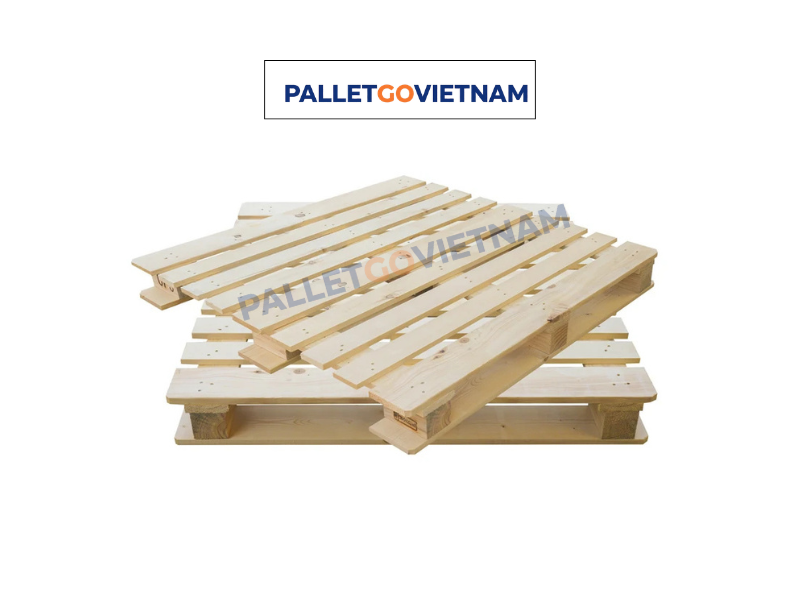
Textiles and footwear are two of Vietnam's largest export sectors, worth tens of billions of dollars each year. The wooden pallet is mandatory packaging and directly affects logistics cost: a lighter pallet saves freight, while an ISPM-15 pallet avoids extra charges at port. ICD Vietnam supplies light pine wooden pallets (14-22 kg), ISPM-15 certified, for garment and footwear export factories.
Textile and footwear goods have their own profile: they are usually lighter than other sectors (often 300-800 kg per pallet) but need pallets meeting strict export standards because most go to the EU and US. International brands (Nike, Adidas, H&M, Zara) typically issue a supplier packaging requirement document specifying pallet detail, especially when cartoned goods sit directly on the wooden pallet inside the container.
Textile-grade wooden pallet specifications
| Specification | EU export (1200x800) | US/general (1200x1000) |
|---|---|---|
| Dimensions | 1200x800x120 or 144 mm | 1200x1000x120 or 144 mm |
| Dynamic load | 500-1,500 kg | 500-1,500 kg |
| Weight | 14-20 kg each | 16-22 kg each |
| Material | HT-treated pine - ISPM-15 | |
| Entry | 4-way | |
For garment export teams: saving freight with a lighter pallet
For garment and footwear export teams, pallet weight directly affects sea freight when a shipment is near the container weight limit. A 40' container has a maximum payload of 26,680 kg (FCL). When goods plus pallets approach that limit, every kg saved on a lighter pallet equals 1 kg more cargo carried. For light garments this matters in practice: 24 pallets x (X kg saved per pallet) = 24X kg added to payload. If X = 4 kg (from a 22 kg pallet down to 18 kg), you save 96 kg of payload, or 96 kg of extra cargo per container.
For procurement: documents to request when buying EU-export pallets
For procurement at an EU-export garment factory, the documents to request from your pallet supplier: (1) an ISPM-15 certificate with the HT method and the treatment facility registration number issued by the Plant Protection Department; (2) a Phytosanitary Certificate if your EU partner requires it; (3) a wood species declaration - some EU brands require the species to confirm it is not from natural forest; (4) a wood moisture test report if required. ICD Vietnam provides this full document set per order. Compare our pine wood pallets and standard pallet sizes.
Applications in textiles and footwear
- Garment factories exporting to the EU and US: Nike, Adidas, Puma, H&M, Zara per supplier packaging spec
- FDI footwear factories: Pou Sung, Taekwang and others - size and standard per each factory's requirement
- 40' textile containers: optimized at 22-24 pallets per layer x 2 layers
- Light cartoned-goods warehouses: light 4-way pallets easy to move where no large forklift is available
Frequently asked questions
Do EU brands require EPAL pallets for textiles?
It depends on the specific contract. Some EU brands require genuine EPAL pallets (to reuse in their pool system), while others only require an ISPM-15 pallet at 1200x800 mm. Ask the buyer directly or check the packaging specification in the purchase order. Where it is not specified, a 1200x800 mm ISPM-15 pallet is sufficient in most cases.
Are wooden pallets affected by container moisture in textile export?
Container moisture (container rain) is a real issue in sea transport. Damp wood releases water vapor that condenses on the goods and causes mold. The solution: use kiln-dried pallets below 18% moisture and add desiccant bags in the container. ICD Vietnam can advise on moisture-protection packaging for textile export containers.
Request a quote for textile wooden pallets
Need pallets for a garment or footwear export factory? ICD Vietnam brings 15 years of experience serving Vietnam export industries. See our full pallet range if your EU partner requires an EPAL pool pallet.
Need a quote for textile pallets? Request a quote with your size, quantity and destination.