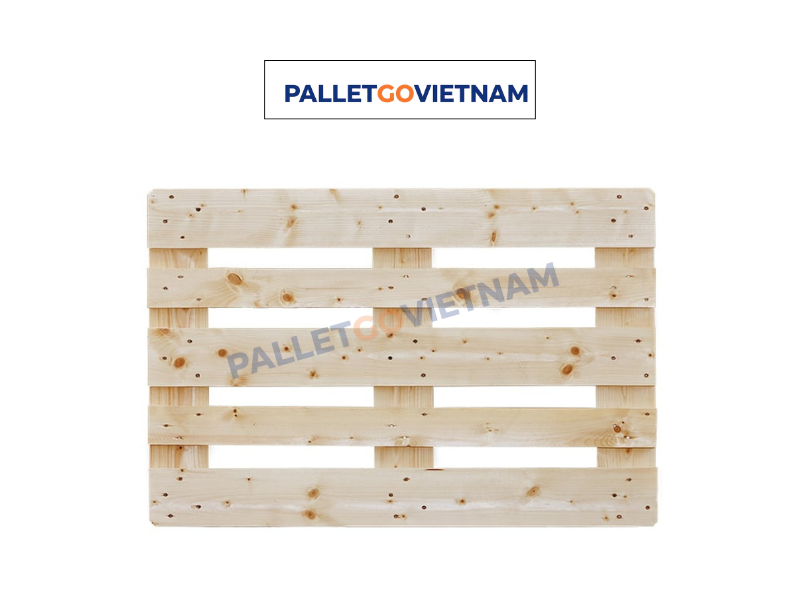
- 2-way entry wooden pallets (stringer pallets) - forklift/pallet-jack entry from 2 opposite sides only
- Standard sizes: 1200x1000 mm and 1200x800 mm - custom dimensions available
- Static load capacity up to 4,000 kg - suited for heavy, stable loads on defined routes
- ISPM-15 heat treatment (HT) available - compliant for export to EU, USA, Australia and 190+ countries
2-Way Entry Wooden Pallets - Stringer Pallets for Export from Vietnam
A 2-way entry wooden pallet (stringer pallet) allows forklift tines or pallet-jack forks to enter from two opposite sides - front and back - only. Built with three solid parallel stringers running the full length of the pallet, this construction delivers a higher static load rating than notched 4-way alternatives, making it the preferred choice for heavy, dense cargo on predictable handling routes. ICD Vietnam has manufactured and exported stringer pallets for 10+ years, supplying B2B importers across Asia, Europe, and the Americas.
Stringer pallets are the most widely produced wooden pallet type in Vietnam. Their simpler construction - three stringers, top deckboards, optional bottom boards - means faster manufacturing lead times and a lower unit cost compared to block pallets. For importers sourcing in volume, the cost advantage per pallet compounds significantly over large orders.
This page covers everything a procurement team or logistics manager needs before placing an order: construction details, standard and custom sizes, load specifications, a direct comparison with 4-way entry pallets, ISPM-15 compliance, and application examples.
What Is a 2-Way Entry Pallet?
A 2-way entry pallet is defined by its entry points - the gaps through which forklift tines or pallet-jack forks pass to lift the pallet. On a stringer pallet, solid boards (stringers) run lengthwise beneath the top deck, creating fork entry only from the two short ends of the pallet. The forks slide under the deck between the stringers, or under the outer stringers, depending on the number of stringers used.
The structural core consists of three stringers - one on each side plus one in the center - made from solid timber typically 75-100 mm wide and 75 mm tall. Top deckboards are nailed or screwed across these stringers. Bottom boards can be added (closed-bottom design) for extra rigidity and racking compatibility, or omitted (single-face design) to reduce weight and cost.
Because the stringers are unnotched and continuous, the structural integrity is higher than a notched stringer - the version sometimes called a "partial 4-way" pallet. This is a key reason stringer pallets often outperform notched alternatives when carrying very heavy static loads.
Standard Sizes and Specifications
ICD Vietnam produces 2-way stringer pallets in the two most common export sizes, plus fully custom dimensions for project-specific requirements. Both standard sizes are recognized under ISO 6780 - the international standard for general-purpose flat pallets.
| Size (L x W) | Common Market | ISO 6780 Code | Typical Height |
|---|---|---|---|
| 1200x1000 mm | Asia-Pacific, Industrial | Type 2 | 120-150 mm |
| 1200x800 mm (Euro) | Europe, retail logistics | Type 1 (EUR) | 120-144 mm |
| Custom | Project-specific | - | Per drawing |
Custom sizes are available with a minimum order quantity (MOQ) of 500 units. Common custom requests include 1100x1100 mm for square loads, 1200x1200 mm for large machinery bases, and non-standard heights to fit specific rack systems.
Load Capacity - Static and Dynamic
Load capacity for wooden pallets is expressed in two ways: static load (the pallet sits on a flat floor, not moving) and dynamic load (the pallet is being carried by a forklift or pallet jack in motion). Static figures are always higher because vibration, acceleration, and tine-point loading all reduce safe capacity during movement.
| Load Type | Capacity Range | Notes |
|---|---|---|
| Static load | 1,500 - 4,000 kg | Pallet on level floor, load distributed evenly |
| Dynamic load (forklift) | 1,000 - 2,000 kg | Pallet lifted and transported by forklift |
| Racking load | 800 - 1,500 kg | Pallet supported on rack beams at two points |
| Pallet-jack (hand truck) | 500 - 1,000 kg | Manual or powered pallet jack on flat surface |
Actual capacity depends on three variables: wood species (acacia/hardwood stringers carry more than pine), stringer cross-section dimensions, and moisture content. ICD Vietnam targets a wood moisture content of below 18% on all export pallets - the threshold required to prevent mold during ocean freight in sealed containers.
2-Way vs. 4-Way Pallets: Which Should You Order?
The choice between a 2-way and a 4-way entry pallet comes down to three factors: handling environment, load weight, and budget. Neither type is universally better - each fits a specific operational profile.
| Factor | 2-Way Stringer Pallet | 4-Way Block/Notched Pallet |
|---|---|---|
| Fork entry sides | 2 sides (long sides only) | All 4 sides |
| Static load | Higher - no notch weakens stringer | Moderate (notched) to high (block) |
| Unit cost | Lower - simpler construction | Higher, especially block pallets |
| Warehouse racking | Suitable - with bottom boards | More flexible positioning |
| Tight/crowded aisles | Less convenient | Better - approach from any side |
| Export shipping | Common choice - cost-effective | Used for high-value or heavy machinery |
| Best for | Linear routes, container loading, defined aisles | Busy distribution centers, automated handling |
For procurement teams: the cost difference
Procurement managers sourcing pallets for export containers typically find that 2-way stringer pallets cost 15-25% less per unit than equivalent-size 4-way block pallets. On a standard 40-foot container loading 400-500 pallets, that difference adds up to a meaningful saving per shipment. If your operation loads pallets onto a conveyor or container in one direction - which is the case for most linear export workflows - the 2-way entry limitation is not a practical constraint at all.
For warehouse and logistics managers: racking notes
Warehouse and logistics managers placing 2-way pallets in selective racking systems should specify the closed-bottom (double-face) design - where bottom deckboards are added beneath the stringers. This distributes the racking beam load across the full pallet width rather than concentrating it on the two stringers, significantly reducing deflection risk. Single-face 2-way pallets (no bottom boards) are suited to floor-stacking and container loading but are not recommended for elevated racking over 1,200 kg.
ISPM-15 Heat Treatment for Export Compliance
ISPM-15 (International Standards for Phytosanitary Measures No. 15) is the mandatory plant quarantine regulation governing all solid wood packaging material used in international trade. Any wooden pallet entering the EU, USA, Australia, Canada, Japan, South Korea, and approximately 190 other signatory countries must carry a valid IPPC mark showing it has been treated to the required standard.
ICD Vietnam applies heat treatment (HT) - the most widely accepted ISPM-15 method - raising core wood temperature to a minimum of 56°C for 30 continuous minutes. Each treated pallet is marked on both sides with the IPPC stamp showing: country code (VN), producer registration number, and treatment method (HT). This mark is the document your customs broker and destination-country port authority will verify on arrival.
All ISPM-15 heat-treated pallets from ICD Vietnam are accompanied by a phytosanitary certificate issued by the Vietnam Plant Protection Department (DARD), which can be included in your export documentation package on request.
Wood Species and Construction Options
ICD Vietnam manufactures 2-way stringer pallets from two primary wood species, each with a distinct performance profile. Choosing the right species for your application avoids over-specifying (paying for strength you do not need) or under-specifying (pallets failing under load).
- Pine wood (Pinus): Density approximately 500-550 kg/m3. Lightweight, cost-effective, widely used for standard export loads under 1,500 kg static. Natural resin content helps resist moisture penetration. Available in heat-treated (HT) grade for ISPM-15 compliance. See our pine wood pallets page for full spec.
- Acacia wood (Keo): Density approximately 700-800 kg/m3. Significantly harder and heavier than pine, suited for loads above 2,000 kg static. Higher durability - pallets withstand 5-8 reuse cycles under normal conditions versus 3-5 for pine. Preferred by importers who reuse pallets in their own facilities.
- Mixed hardwood: Combination of locally available hardwood species. Mid-range density and cost. Common for one-way export pallets where reuse is not required.
Applications and Industries Served
2-way entry stringer pallets are the dominant format in Vietnam's export manufacturing sector. ICD Vietnam supplies them across a broad range of industries where loads move predictably along defined routes - container loading bays, conveyor lines, and linear warehouse aisles where 4-way access is not operationally necessary.
- Consumer goods export: Electronics, textiles, and packaged goods destined for EU, USA, and Japan - where ISPM-15 compliance is mandatory
- Food and beverage: Bagged goods (rice, coffee, animal feed) loaded in rows into 20-foot and 40-foot containers - 2-way access aligns perfectly with straight container-loading workflow
- Chemicals and industrial materials: Drums, IBC containers, and sacked raw materials - heavy static loads where the stringer pallet's higher capacity is the deciding factor
- Machinery and spare parts: Custom-size pallets built to the footprint of specific equipment, with reinforced stringers for concentrated point loads
- Cold chain logistics: Hardwood stringer pallets resist moisture better in refrigerated environments; closed-bottom design prevents condensation pooling on the pallet base
Customization and Production Capacity
Standard sizes ship within 5-10 business days from order confirmation for quantities up to 2,000 units. Custom-size orders require a 3-5 day additional lead time for tooling and first-article approval. ICD Vietnam can supply up to 50,000 units per month across all stringer pallet types.
Customization options available on request:
- Non-standard footprint dimensions (length, width, and height)
- Stringer cross-section upgrades for higher load requirements
- Top deckboard spacing and count (open-deck vs. closed-deck)
- Bottom boards: single-face (no bottom) or double-face (with bottom boards)
- Nail pattern and fastener type (ring-shank nails for higher withdrawal resistance)
- ISPM-15 heat treatment with IPPC marking (standard or express service)
- Custom branding: paint, stencil, or laser marking on deckboards
Frequently Asked Questions
Can a 2-way stringer pallet be used in racking?
Yes, provided the pallet has bottom boards (double-face design) and the racking load does not exceed the pallet's rated capacity for that configuration - typically 800 - 1,500 kg for standard pine stringer pallets. The pallet must be oriented so the stringers run perpendicular to the rack beams, distributing the supported weight across all three stringers. Single-face stringer pallets (no bottom boards) are not recommended for elevated racking.
What is the difference between a stringer pallet and a block pallet?
A stringer pallet uses three continuous boards (stringers) running lengthwise under the deck - this creates 2-way entry. A block pallet uses nine solid wooden blocks (at corners, edges, and center) instead of stringers, creating 4-way entry from all sides. Block pallets are heavier, more expensive, and offer more flexible handling. Stringer pallets are lighter, lower cost, and deliver higher static load capacity per dollar - making them the standard choice for high-volume export shipments.
Do your 2-way pallets come with an ISPM-15 certificate?
Yes. All heat-treated pallets from ICD Vietnam carry the IPPC mark stamped on both sides of each pallet, and a phytosanitary certificate from Vietnam's Plant Protection Department is available on request. The IPPC mark includes the Vietnam country code (VN), our registered producer number, and the treatment method code (HT). This documentation is accepted at ports in the EU, USA, Australia, Japan, South Korea, and all other ISPM-15 signatory countries.
What is the minimum order quantity (MOQ) for export?
MOQ for standard sizes (1200x1000 mm and 1200x800 mm) is 200 units. For custom-size orders, MOQ is 500 units. Full-container orders (typically 400-500 pallets per 40-foot container) receive priority production scheduling and can be ready within 7 business days for standard specifications.
Request a Quote for 2-Way Wooden Pallets from Vietnam
ICD Vietnam - palletgovietnam.vn - has supplied wooden pallets to international buyers for 10+ years. Our team responds to export inquiries within 1 business day. For 2-way stringer pallets, share your required size, quantity, load specification, and whether ISPM-15 treatment is needed - we will return a CIF or FOB price within 24 hours.
Contact our export sales team directly via WhatsApp, phone, or email:
- Tel / WhatsApp: +84 983 797 186
- Email: sales@icdvietnam.com.vn
- Contact form: palletgovietnam.vn/en/contact/